Wednesday, August 20, 2014

Caterpillar Egg Update

Yesterday this Monarch Butterfly egg was ready to hatch when photographed in the afternoon.  A friend said it looked like a "Pop Bead".

The bead has popped!
Today the egg has hatched and the caterpillar is busy munching on the milkweed leaf that held the attached egg.  The scale at the top of the picture is graduated in millimeters (25.4mm per inch).
The tentacles have not formed yet on the anterior and posterior of the body and the head is the same width as the body.  I will try to photograph the caterpillar as it grows through the instar stages and post them on this blog.
Photos by J. Ormiston


Oh Deer!! Whitetail Fawns.

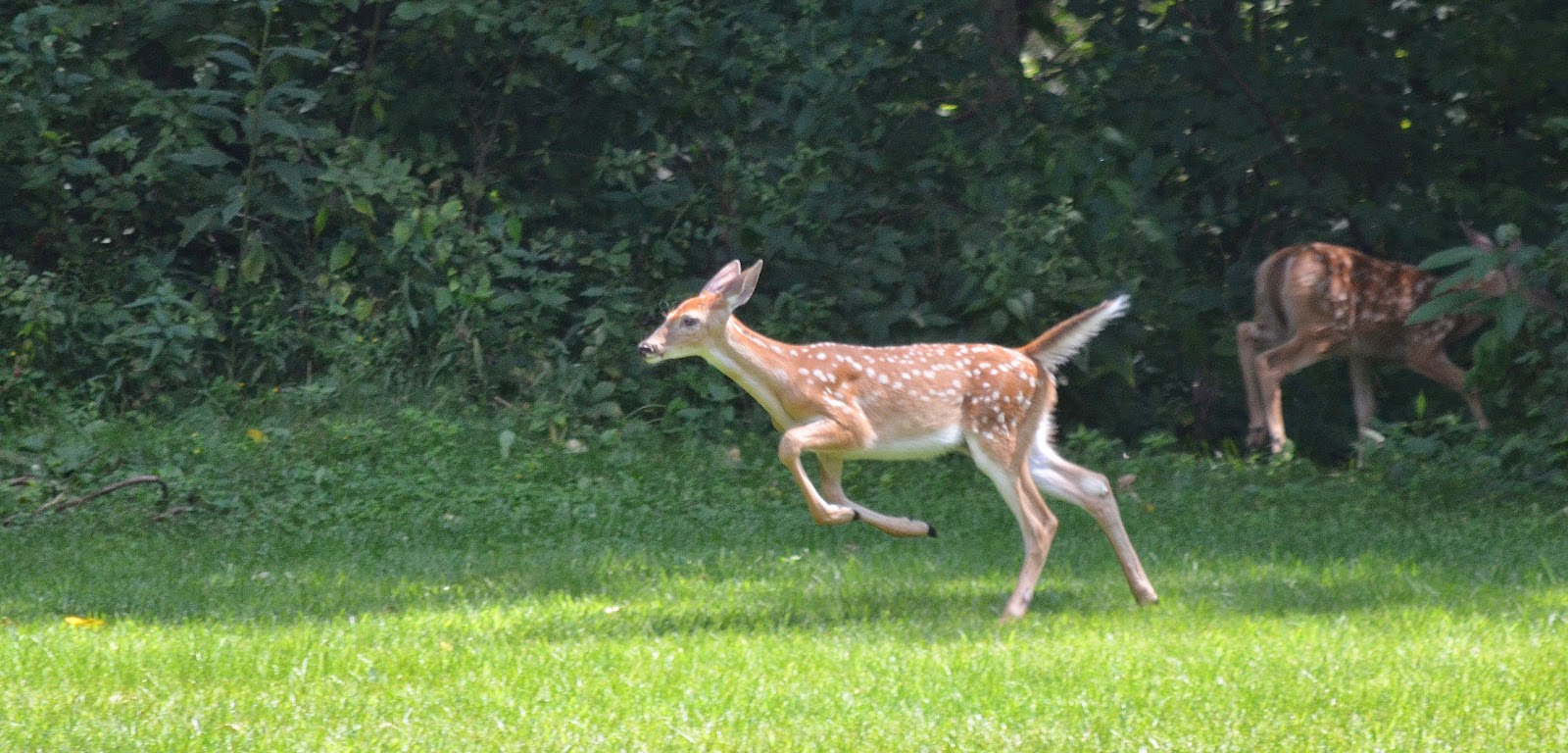
One of the most enjoyable things about working at Fox Island County Park is sharing nature with young visitors.  Today some of our young visitors were able to see two White-tailed Deer fawns (Odocoileus virginianus) feeding and romping in the lawn east of the Nature Center. While very aware of the people watching from the front of the Nature Center the nearly full grown fawns seemed to feel safe enough to come out in the open with occasional trips back into the wooded area.
This fawn will soon loose it's spots as fall approaches.  Deer will be feeding heavily right now as they need to add fat for the approaching winter.  White-tailed deer are the most economically important wild mammal in the United States generating billions of dollars annually in hunting dollars.  Whitetail deer were hunted heavily in the mid-1800's and populations decreased to around 1 million nation wide.  Today's numbers are in the estimated range of 25 to 27 million nationally.
White-tailed deer have excellent senses of sight, hearing and smell.  This fawn is licking it's nose to improve it's ability to to smell the observers standing a few yards away. Deer have about 50 times the number of smell receptors that humans have and a wet nose is a more sensitive nose.  Deer also have smell receptors in the roof of their mouth.
When startled White-tails lift their tail and show the "flag" that gives them their name. The hairs also
are fanned out and the tail is moved back and forth to alert other deer to beware.  Many times the only sight you have of a deer is the white tail bobbing through the woods as it departs the area.
The first fawn was soon joined by it's sibling and began running around obviously burning off excess energy before disappearing back into the woods. The mother never came out onto the lawn but rest assured she knew where they were every moment.  Before the kids left the park I was able to give each a color print-out of the fawns they were able watch and enjoy.




Tuesday, August 19, 2014

The beginning of a Monarch

Monarch Butterflies start their journey to adulthood as a tiny egg usually laid by the female on the underside of a milkweed leaf. The football shaped eggs are only slightly larger than a grain of sugar and milky white in appearance. A female lays only one egg per plant and usually on the upper half of the milkweed plant on young leaves.
In 3-5 days,  just before the tiny caterpillar emerges from the egg the egg appears to have a black cap.  This black end of the football is actually the newly formed head of the caterpillar inside the egg case.  In this egg the 3 black fore legs of the caterpillar are visible at the lower edge of the head in the center of the egg. These eggs are beautifully fluted and serrated in contrast to the eggs of other animals that have a very smooth egg case. Why?
This caterpillar was photographed within minutes of emerging from the egg.  The caterpillar immediately begins to eat the egg case and then will begin to eat the tiny hairs on the back side of the leaf in order to get the energy needed to carry on the business of becoming a productive adult.
Photos by Jeff Ormiston.

Thursday, August 14, 2014

Giant Swallowtail II

Today another Giant Swallowtail butterfly came to our butterfly bush attracted by the fragrant blossoms.
While slightly less worn than Saturday's Swallowtail it was still showing the signs of a well traveled butterfly carrying on the business of promoting the survival of the species.
The Giant Swallowtail is Indiana's largest swallowtail.
Even though this Common Clearwing (Hummingbird Moth) is only about the size of the Giant Swallowtail forewing it is still attracted to the blossoms of the same butterfly bush.  Clearwing caterpillars feed on hawthorn, viburnum, honeysuckle and mint.


Tagged Monarchs

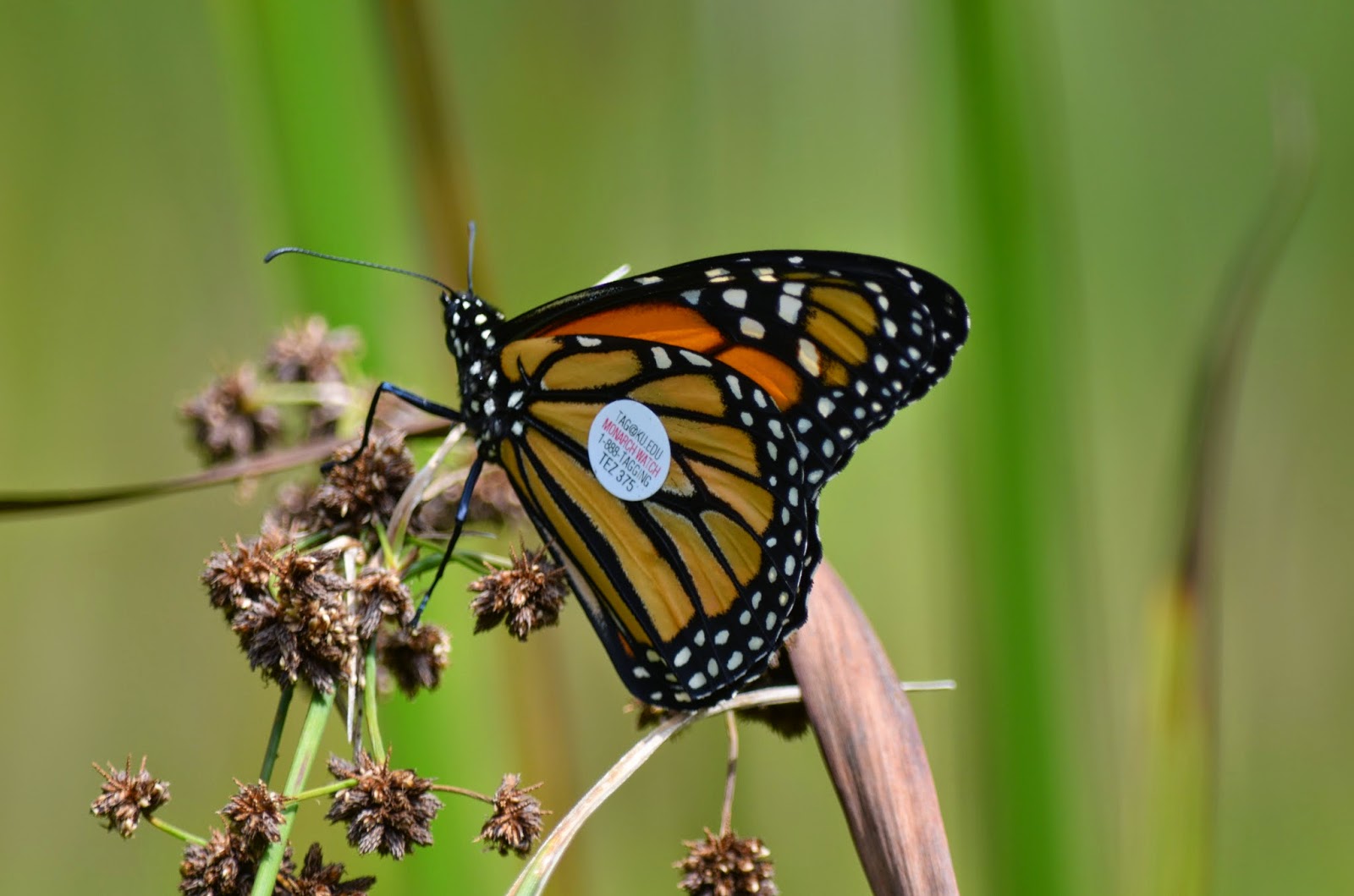
What we now know about the annual migration of the Monarch Butterfly is made possible, in large part, by the tagging of adult Monarchs and recovery of those tagged adults. Peak Monarch migration at our latitude is early September but I have tagged the adults released this week and used it as an educational experience for visiting kids and adults.
Yesterday morning I released and tagged a male Monarch and today while at the Nature Center wetlands at Fox Island I photographed what I thought was the butterfly I had released a couple hours before but was actually the butterfly released on the previous day.
This young visitor released our second tagged Monarch this morning.

Tuesday, August 12, 2014

Tree Frog and Water Snake

While out checking milkweeds for Monarch eggs and caterpillars I encountered this Eastern Gray Tree Frog (Hyla versicolor) perched on a large milkweed leaf and blending in nicely using it's green color selection.  With the ability to change colors to blend with it's background this frog spends it's life in trees and bushes above ground coming back to earth only to breed and lay eggs. 

Another unexpected sighting was this Northern Banded Water Snake that was laying a few inches from the walkway of the Fox Island Nature Center side entrance. This non-venomous water snake has traveled several yards away from the nearest pond in search of toads and frogs in the flower bed.  As these snakes grow older they become darkly colored sometimes becoming nearly black.  This 24"snake displays the banding that gives it it's name.


Saturday, August 9, 2014

Giant Swallowtail


This Giant Swallowtail Butterfly (Papilio cresphontes) flew through my front yard, paused briefly at my Oak Leaf Hydrangia, and continued on to the Butterfly Bush in my back yard. Giant Swallowtails are one of the three largest butterflies in North America and have a range that includes most of the US. The wing span of a Giant Swallowtail can reach up to 5 1/2".

Also known as "Orange Dog", in Florida, due to the fact that citrus trees are the caterpillar's host plant in that area. In Indiana the host plant is the Common Prickly Ash (Zanthoxylum americanum).
  The butterfly was kind enough to display both sides of it's wing surfaces which also shows how worn and tattered the wings are. Unfortunately this beautiful butterfly is at the end of it's adult stage.